Book a Consultation
Classifications and Credentials:


What to Expect During a Turnkey Railroad Construction Project Timeline
When railroad operators and facility managers come to us about a large-scale construction project, one of the first things we hear is some version of the same concern: “We don’t really know what we’re getting into.”
At Track Tech Inc., we’ve been managing these projects since 1980, serving railroad operators, industrial facilities, and transportation companies across Kentucky, Illinois, and Tennessee.
How the Turnkey Model Reshapes the Entire Project Experience
Turnkey railroad construction eliminates that friction. When we take on a project, we bring all of those capabilities under a single project plan. Our team handles track work, catenary line installation, grade crossing renewal, turnout installation, and automation system integration in a coordinated sequence. There’s no waiting for one contractor to vacate the site before another can begin. We schedule the work ourselves, and when something shifts, we adjust internally without pulling the client into every decision.
We also hear concerns from operators who worry that a turnkey contract means less visibility into costs and scope. That’s a fair concern, and we address it directly. Our contracts include clearly defined milestones, transparent material and labor breakdowns, and a formal change order process so that any scope adjustments are documented and priced before the work happens. There are no surprises buried in the final invoice.
Pre-Construction: Site Evaluation, Engineering, and Permitting
Pre-construction is where the project either gets set up for success or inherits problems that surface later at a much higher cost to fix.
Our pre-construction work begins with a thorough site survey. We assess existing track conditions, drainage patterns, soil stability, and right-of-way constraints. If there’s existing infrastructure on the site, we evaluate its condition to determine what can be incorporated into the new design and what needs to be removed or replaced. Geotechnical assessments tell us what the subgrade can support, which directly influences decisions about ballast depth, tie spacing, and foundation preparation for structures like bridges or retaining walls.
Once we have a clear picture of the site, our engineering team begins the design process. Rail layout planning takes into account the operational requirements our client has shared with us: train speeds, axle load capacities, the number and frequency of switching movements, and any future expansion plans. Grade calculations, curve geometry, and material specifications all flow from those operational parameters.
The permitting phase runs in parallel with engineering wherever possible, but it’s worth being direct with clients about one reality: permitting almost always takes longer than people expect. Depending on the project scope and location, we may be coordinating with the Federal Railroad Administration, state transportation agencies, local municipalities, and environmental review bodies. Projects that involve federal funding or federal land may trigger review under the National Environmental Policy Act, which adds time to the process regardless of how well-prepared the application is.
Understanding FRA railroad compliance requirements early in the process helps avoid costly delays during the permitting phase.
Material Procurement and Mobilization
Once engineering is finalized and permits are in hand or well along in the review process, we move into procurement and mobilization.
Rail, ties, ballast, turnouts, signal equipment, and catenary components each have their own supply chains and lead times. Turnouts in particular, which are precision-manufactured assemblies, can require significant advance ordering depending on the configuration and the manufacturer’s current production schedule. Understanding the complexity of turnout installation helps explain why these components demand such careful procurement planning.
Mobilization runs alongside the tail end of procurement. This is when we stage equipment, assemble crews, and establish the site logistics that will govern the project through active construction. Our on-track safety and flagging protocols are established during mobilization, not as an afterthought once work begins. This planning sets the operational framework for how crews move on and around active track, how equipment is positioned, and how we coordinate with any railroad traffic that continues to operate during construction.
Active Construction: What the Work Actually Looks Like
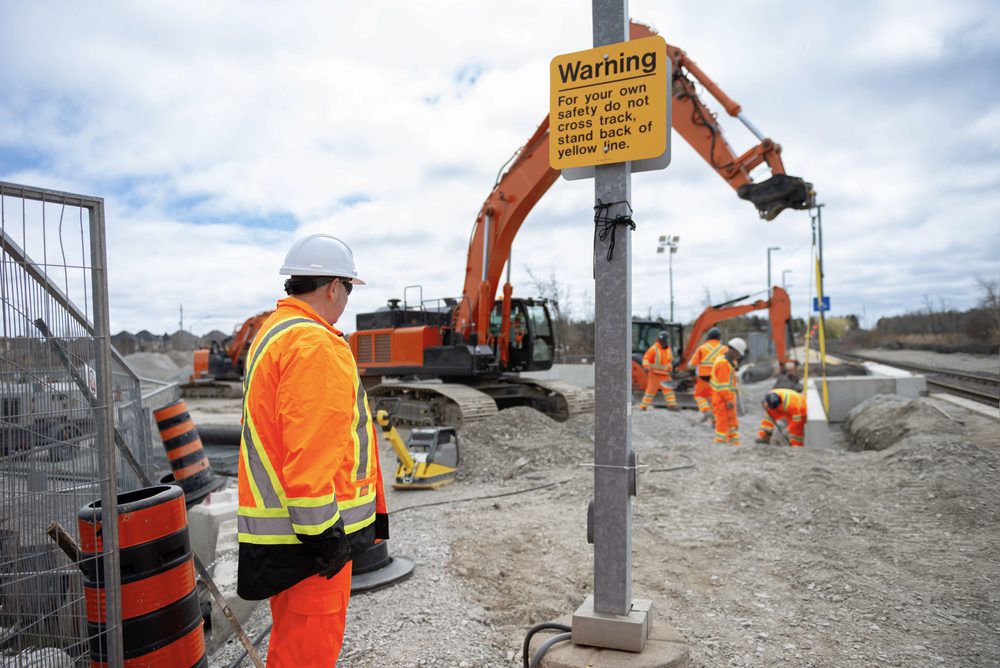
Core track construction follows a logical progression. Subgrade preparation comes first, grading and compacting the foundation to the specified tolerances. Ballast is then placed and shaped to support the track structure. Tie installation follows, with ties positioned according to the spacing called out in the design. Rail is laid and fastened, joints are made, and the track is brought to rough alignment. Turnout installation happens at designated switching locations, requiring precision work to ensure the geometry meets both design specifications and FRA standards. Surfacing, the process of bringing the track to final line, grade, and cross-level, is typically the last major track activity before inspection.
Depending on the project scope, several specialized work streams may run in parallel with core track construction. Catenary line installation, for facilities that require overhead electrification, involves its own crew and equipment working in coordination with the track team. Grade crossing renewal, where the track intersects with roadways, requires coordination with local traffic management. Railroad automation and signal system integration may involve both our crews and equipment vendors working simultaneously in different parts of the project corridor.
Temporary track closures or slow orders may be necessary for portions of the work, and we communicate those windows well in advance so clients can plan their operations accordingly. Our project manager provides regular progress updates, typically on a schedule agreed upon at project kickoff, so clients always know where the work stands relative to the overall timeline.
Weather, unexpected subsurface conditions, and utility conflicts are among the most common sources of schedule variability during active construction. We build contingency thinking into the schedule from the start and address these situations as they arise rather than waiting to see how they resolve themselves.
Testing, Inspection, and the Path to Project Closeout
Track geometry testing evaluates the finished track against tolerances for gauge, alignment, surface, and cross-level. Gauge verification confirms that the rail spacing meets FRA standards throughout the project corridor. Joint inspection examines rail connections for proper fit and fastening. If signal systems are part of the scope, those are tested for correct function, including circuit continuity, switch position indication, and any automation logic that governs train movements. Catenary systems undergo energization checks to verify correct tension, height, and electrical performance before the overhead is put into service.
We coordinate with the appropriate regulatory bodies for final compliance reviews. For FRA-regulated track, this means ensuring the finished work meets the applicable class of track standards under 49 CFR Part 213 before revenue operations begin. Our professional railroad track inspection capabilities are built into the closeout process, not added as an afterthought, so that any issues identified during testing are addressed before the formal handoff.
We deliver a complete documentation package at closeout that includes as-built drawings, maintenance manuals, warranty information, and any regulatory correspondence related to the project. The formal project closeout meeting with the client gives both parties a chance to review the completed work, confirm that all punch list items are resolved, and discuss the transition into ongoing maintenance.
Life After Handoff: Protecting the Investment
The track, turnouts, grade crossings, and systems we’ve built represent a significant capital investment, and protecting that investment requires a structured maintenance program. We help clients establish maintenance schedules that account for traffic volume, axle loads, and the specific conditions of their corridor. Tie replacement cycles, ballast cleaning intervals, and periodic track inspections are all part of a maintenance plan that keeps the railroad operating safely and extends the service life of the infrastructure.
Our warranty support means that if issues arise in the period following construction, we’re available to address them. We also maintain emergency response capabilities for clients who need rapid support when something unexpected happens on their railroad. Because we operate throughout Kentucky, Illinois, and Tennessee, we’re geographically positioned to respond quickly rather than dispatching from a distant location.
The relationship also evolves as clients’ operational needs change. Many of the facilities and operators we work with come back to us when they’re ready to expand their rail infrastructure, add a new spur, or upgrade an aging section of track. Learning what full-service railroad construction contractors provide helps operators understand the breadth of support available for future projects.
Putting It All Together
At Track Tech Inc., we’ve been delivering turnkey railroad construction projects since 1980, with clear timelines, proactive communication, and work that meets or exceeds FRA standards. If you’re planning a project in Kentucky, Illinois, or Tennessee, explore our services and reach out to our team.