Book a Consultation
Classifications and Credentials:


Continuous Welded Rail vs. Jointed Rail: Why Modern Track Has Fewer Joints
If you’ve ever wondered why most modern track no longer clatters like it used to, the answer comes down to one change: continuous welded rail replacing the bolted joints that once connected every rail segment. We’ve installed and maintained both types of track across Kentucky, Illinois, and Tennessee, and the difference in how they behave under traffic and temperature is notable. In this article, we break down why jointed track struggles, how continuous welded rail solves that problem, how we join rail in the field with thermite welding, and the thermal tradeoffs that come with running rail without joints.
Why Bolted Joints Are the Weak Point in Jointed Track
Traditional jointed rail comes in fixed lengths, typically 39 feet in the US, connected end to end with joint bars bolted across the rail web. That connection point is a mechanical discontinuity. Instead of one continuous beam carrying wheel loads smoothly, you have two rail ends meeting at a gap, each one flexing independently as a train passes over it.
Every wheel that crosses a joint delivers an impact load at that gap, even a small one. Over thousands of passes, that impact accelerates wear on the joint bars, loosens the bolts, and enlarges the bolt holes in the rail itself. Once the holes wear oversized, the joint bar can no longer hold the rail ends in tight alignment, and the gap grows. A growing gap means a harder impact on the next wheel, which wears the joint further. It’s a cycle that only moves in one direction without intervention.
Jointed rail also needs those gaps by design, not by accident. Steel expands when it heats up and contracts when it cools, so a small expansion gap at each joint gives the rail somewhere to grow in summer without buckling. The problem is that the same gap engineered to solve a thermal problem becomes the exact spot where mechanical degradation starts. Water and debris collect there, corrosion sets in around the bolt holes, and the joint becomes a maintenance item that never really goes away. On a mile of jointed track, you might have well over a hundred of these vulnerable points, each one needing periodic attention. That’s the tradeoff jointed rail makes: predictable thermal behavior in exchange for a track structure with built-in weak spots every 39 feet.
How Continuous Welded Rail Eliminates Most Joints
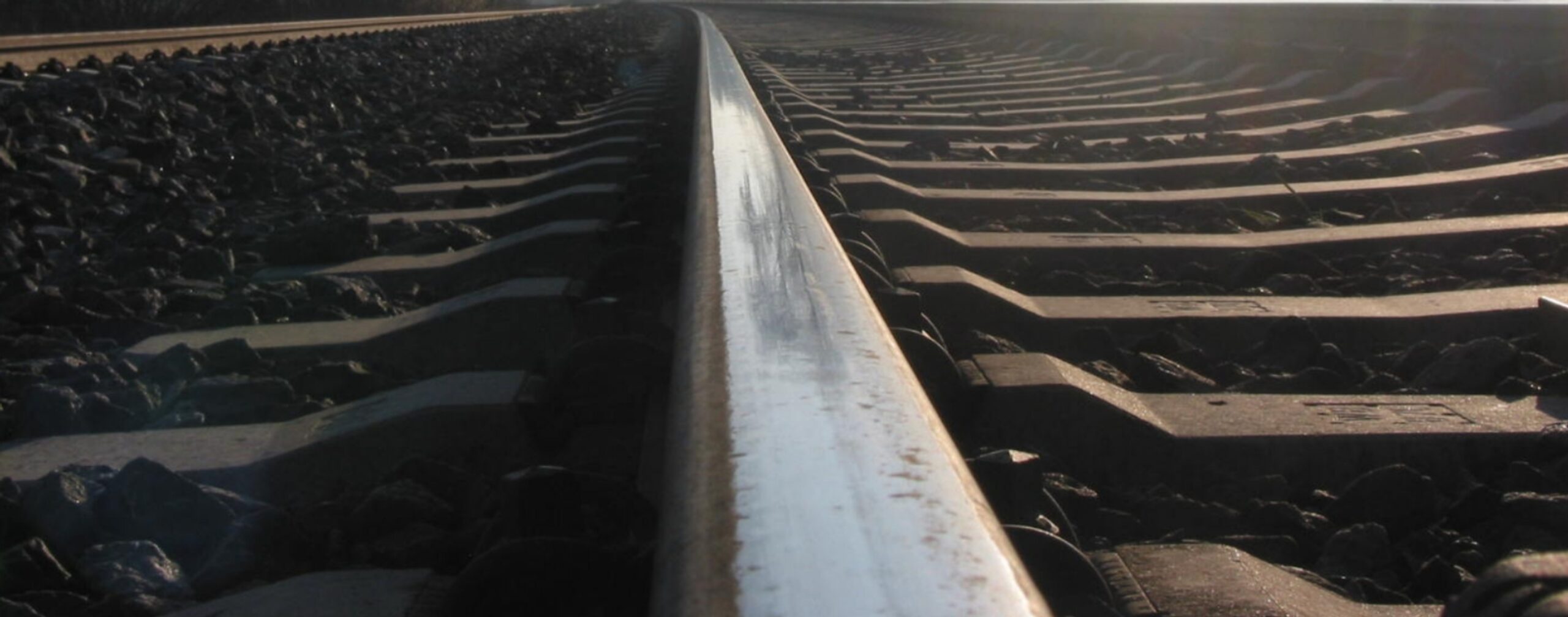
Continuous welded rail, usually shortened to CWR, takes those standard rail segments and welds them together into much longer strings, often a quarter mile or more, before they’re ever anchored into the track structure. Instead of a joint every 39 feet, a CWR corridor might have only a handful of welded connections per mile, mostly at insulated joints needed for signal circuits or at transitions to other track segments.
Removing most of the joints removes most of the impact loading that comes with them. Wheels roll across a continuous steel surface instead of bouncing over a series of small gaps. That has a real effect on the rest of the track structure. Ties take less repeated shock loading at any single point, fasteners loosen more slowly, and ballast underneath stays compacted longer instead of getting pounded loose at predictable joint locations. We cover how that plays out over the life of a track structure in our article on how long railroad track lasts, and the connection between ballast condition and joint impact is part of what we discuss in what railroad ballast does.
Any honest CWR vs. jointed rail comparison also has to mention ride quality and noise, because operators notice both immediately. Jointed track produces that familiar rhythmic clatter as wheels cross each gap. CWR removes most of that noise and delivers a noticeably smoother ride, which matters if you’re running frequent passenger service, moving sensitive freight, or operating near residential areas where noise complaints are a real concern. For facilities and short lines weighing whether a CWR conversion is worth the upfront cost, the reduction in long-term impact wear on ties, fasteners, and ballast is usually the strongest argument, more so than ride comfort alone.
How Thermite Welding Joins Rail Sections in the Field
Stringing rail into quarter-mile sections doesn’t happen in a shop. It happens on the ground, in the field, using a process called thermite welding. The process uses a chemical reaction between aluminum powder and iron oxide that burns at extremely high temperatures, producing molten steel on the spot. Crews position a mold around the gap between two rail ends, ignite the thermite mixture in a crucible above the mold, and let the molten steel pour down into the gap, fusing the two rail ends into one continuous piece of steel.
The appeal of thermite welding is that it doesn’t require moving rail sections to a fixed welding plant. Our crews can join rail directly in place along the right-of-way, which is what makes it practical to convert existing jointed track to continuous welded rail without shutting down a line for an extended period or trucking rail back and forth. It’s also the standard method for closing gaps left after tie replacement work or after a broken rail repair, so it shows up regularly in ongoing maintenance, not just in new CWR installation.
The quality of a thermite weld depends heavily on preparation. The rail ends need to be properly aligned and gapped before the mold goes on, and the rail itself needs to be preheated to the right temperature before the pour. Skip either step, and you risk a weld with internal voids, poor fusion, or misalignment that leaves a slight dip or bump at the joint. A weld like that doesn’t fail immediately, but it behaves like a hidden joint, concentrating stress and wear at that one spot even though there’s no bolt or gap to see. That’s why we treat preheat time and rail alignment as non-negotiable steps rather than something to rush through to keep a work window moving. A rail line is only as good as its weakest weld, and a bad thermite joint can undo a lot of the benefit that continuous welded rail is supposed to provide.
The Thermal Stress Tradeoff: Rail Neutral Temperature, Sun Kinks, and Pull-Aparts
Eliminating expansion gaps solves the joint wear problem, but it doesn’t eliminate the fact that steel still expands and contracts with temperature. CWR handles this differently than jointed rail does. Instead of leaving room for the rail to move, we anchor it firmly to the ties at a specific installation temperature, called the rail neutral temperature, chosen so the rail sits at close to zero internal stress across the range of temperatures it will typically see in service.
When rail temperature climbs well above that neutral point, usually on hot summer days with direct sun exposure, the rail wants to expand, but the anchoring won’t let it move. That energy has to go somewhere, and it builds up as compressive stress inside the rail. If the stress gets high enough, and especially if ballast support or anchoring has weakened in a spot, the track can suddenly buckle sideways. This is what’s known as a sun kink, and it can happen quickly enough to catch a train mid-transit if it isn’t caught first through inspection or track monitoring.
The opposite problem shows up in cold weather. When rail temperature drops well below neutral, the steel wants to contract, and if the tensile stress gets high enough, it can pull apart at a weld or fastener location rather than gradually flexing the way jointed rail’s expansion gaps were designed to accommodate. A pull-apart is essentially a broken rail caused by cold-weather tension rather than a mechanical fatigue failure.
Both failure modes point to the same underlying lesson: continuous welded rail shifts what needs monitoring. Instead of watching bolt torque and gap width as you would with jointed rail, you’re watching anchoring condition, fastener integrity, and how far the actual rail temperature has drifted from the neutral temperature it was installed at. This is closely tied to broader track geometry concerns, which we cover in more depth in our track geometry pillar article. Getting rail neutral temperature right at installation, and keeping anchoring in good condition afterward, is what keeps CWR from trading one maintenance problem for a more dangerous one.
Why Jointed Track Still Carries a Heavy Maintenance Burden
Plenty of jointed track is still in service across our region, whether in older yards, industrial spurs, or sections that haven’t yet been converted to CWR, and it still demands a specific kind of upkeep that welded rail doesn’t. Rail joint maintenance is an ongoing task, not a one-time fix. It typically includes:
- Checking bolt torque at joint bars on a regular schedule, since vibration works bolts loose over time
- Inspecting joint bars themselves for cracking or wear that reduces their ability to hold rail ends in alignment
- Measuring and adjusting expansion gaps that widen as bolt holes wear oversized
Facilities still running significant stretches of jointed rail often see recurring costs concentrated right around those joint locations. Joint bars need periodic replacement, and the ties directly under a joint tend to deteriorate faster than ties elsewhere in the same section because they absorb more repeated impact. If tie condition near joints has gotten bad enough, our tie replacement services team often ends up targeting exactly those spots first, since that’s where the damage concentrates.
Regular track maintenance and inspection can flag a failing joint well before it becomes a safety issue, catching a widening gap or a cracked joint bar while it’s still a scheduled repair rather than an emergency. If you’re running jointed track and haven’t had it reviewed recently, that’s a good place to start, regardless of whether a full CWR conversion is on your radar yet.
Deciding What’s Right for Your Track
Continuous welded rail isn’t maintenance-free, but it trades the constant joint upkeep of bolted rail for a smoother, quieter track that needs careful attention to rail neutral temperature and anchoring instead. Neither option is free of upkeep; the question is which kind of maintenance fits your traffic, your climate exposure, and your budget better. If you’re weighing a CWR conversion or need your existing jointed track inspected, reach out through our home page or contact page. At Track Tech, we’ve worked with jointed and welded rail across Kentucky, Illinois, and Tennessee long enough to know there’s rarely a one-size-fits-all answer. Learn more about our services, and we’ll walk through what makes sense for your line.